Sustainable Music

Translate

Showing posts with label Thoreau. Show all posts

Wednesday, February 28, 2024

The trouble with the trouble with wilderness

Roaring Falls, Glacier Bay National Park. Courtesy National Park Service.

      Toward the end of the last century, William Cronon deconstructed the prevailing definition of American wilderness, as nature apart from the influence of humankind. Henry Nash Smith's classic in American studies, Virgin Land (1950), had summed up the role that the myth of the frontier, as unexplored and unsettled wilderness, had played in American life. As long as American settlers, Cronon argued, had conceived of the American frontier as wilderness, the land was available for possession and settlement. The trouble with wilderness, Cronon pointed out, was that it ignored millennia of Native American settlement on this same land; indeed, Natives were erased from the land both literally, and then figuratively by the idea of wilderness. 

    But when did this particular idea of wilderness actually arise? Was it present during the days of settlement when the Natives were being erased? It would not appear so. William Bradford, Colonial Governor of Massachusetts, described a different kind of frontier: a "hideous wilderness, filled with wild beasts and wild men." The wilderness Bradford described was populated with Natives and animals that were a threat to the settlers. Wilderness was not, for the early settlers, land absent the hand of mankind. It would seem that while the idea of wilderness as "the natural world" apart from human influence was present among intellectuals like Emerson and Thoreau, it didn't become fully established in American culture until the Conservation Movement. Starting in the late 19th century, when National Parks were beginning to be constructed in order to preserve nature, because "it was morally right to do so," as John Muir had argued, this idea of wilderness as land in its natural state became prevalent in American public discourse. Not coincidentally, the Conservation Movement arose at a time when the American Frontier had been formally declared closed (1890).

    The trouble with the trouble with wilderness, then, is that American settlers had not always conceived of it as empty land ready for possession. It was not, in fact, until it had been fully possessed that the modern idea of wilderness, which Cronon critiqued, came to prevail, fueled by the ideas that were rooted in the Conservation Movement. In effect, Cronon's critique, as he came to recognize, was not so much a critique of American settlement as a critique of the Conservation Movement's idea of wilderness.

Monday, February 20, 2023

Music, Sound and Nature

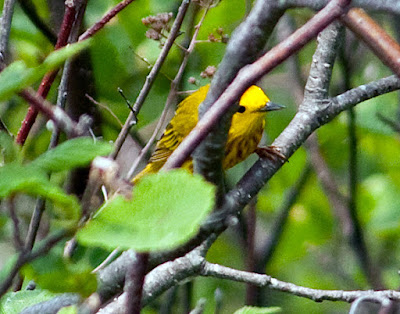
Yellow warbler. Photo by Jeff Titon, 2010.


I begin with a bit of news: FeedSpot has selected Sustainable Music as one of the fifteen best musicology blogs and websites. I appreciate their recognition of this blog, maintained since 2008.

What follows now is a short introduction, for high school and first-year college students, to the topic of music, sound and nature. I wonder if ChatGPT would produce anything similar. I plan to find out. In any case, I wrote this essay in 2019 and have just now imported it into this blog, but I can't seem to overcome the strange formatting triggered by the endnote numbers in the text. So be it, and my sincere apologies for any difficulties in reading. 


EARTH SONG: MUSIC AND THE ENVIRONMENT


         All over the globe, and throughout history, people have recognized deep connections between music, sound, and nature. The 3rd century B.C.E. Chinese Taoist text, the Zuangzi, asks “You may have heard the [musical] notes of Man, but have you not heard those of Earth?”[1] Henry David Thoreau wrote in his journals of the comforting hum of the “earth song,” the music made by frogs, crickets, and other animals.[2] This essay links earth song to human-made sounds and music for social change and a more sustainable future. 


Sounds tell us a lot about the environment. The natural landscape and the built environment surround us with sounds, whether the sounds of thunder, the whoosh of the wind shaking the trees, the ring of the church bell, the bang of the drum, the alarm-call snorts of deer, the hum of the refrigerator or the scream of the police car siren. We wonder why birds sing.[3] What kind of language is bird song? Is it like human language, or are they just signaling--“danger!” or “here I am?” Have you ever tried to talk with a bird, singing back its melody?[4] Living beings communicate by means of sound. If their acoustic channels (“acoustic niche” is the technical term) are blocked, they either fail to get their signals through or they may try another channel. Birds that live near highways sing higher to avoid being blocked by traffic noise.[5]


We call the characteristic sounds of a place its soundscape. Soundscapes consist of anthrophony (sounds made by human beings), biophony (sounds of nonhuman beings), and geophony (sounds of the Earth, such as wind, rain, thunder, earthquakes, and glaciers). You can imagine how important sounds must have been in an earlier America.[6] Who has not heard of the Liberty Bell? The ringing of large bells could be heard over very long distances. People marked the passing of time with bells ringing in clock towers; bells called children to school and churchgoers to church. The chugging of the railroad locomotive, the clicking of the cars on the tracks, and the scream of the railroad whistle became common sounds in the 19th century.[7] As the trains rolled through the countryside, many a farmer out in the fields hoeing corn or chopping cotton wondered what it would be like to travel and start a new life in some distant city. Many a “railroad blues” song expresses those feelings while a harmonica imitates the sound of the train whistle.[8] What might Rachel Carson have meant when she titled her book about pesticide misuse Silent Spring?[9]     


Soundscapes have interested sound collectors ever since it became possible to make recordings. In some countries, such as Japan, sound collecting has been going on for many decades.[10] Moses Asch, founder of Folkways Records, encouraged collectors of biophonic, geophonic, and anthrophonic sounds and released them on LPs beginning in the 1950s. You can still hear those Folkways albums featuring the sounds of frogs and other amphibians, birds, thunderstorms, even rooms filled with typewriters clicking away (typing pools, as they were called back then).[11] Today’s international sound collectors get together on the internet to share their recordings and technical expertise.[12]


Soundscapes inspire composers of music in various ways. 20th-century musique concrète composers sampled and mixed recorded environmental sounds into their musical performances. John Cage’s famous 4’ 33” is a composition in which the musicians do nothing for the four minutes and thirty-three seconds’ duration of the composition. The only “music” the audience hears is the soundscape of the room in which the “performance” occurs. Contemporary sound installations are sited so as to integrate musical compositions with environmental sounds, indoors and out. Environmental sound art not only awakens listeners to the soundscape but also to environmental impacts of noise pollution (as from airplane flyovers in the National Parks) and habitat change. Some composers have taken down bird songs in musical notation, and others have incorporated, imitated, or transformed bird song phrases in their compositions. In Chinese music such as “100 Birds Courting the Phoenix,” for suona (oboe) and ensemble, extended passages are a virtual catalog of bird calls and songs imitated by instruments.[13] But birdsong played an even more important role in traditional Chinese music. According to the ancient book of the Chunqiu, in the 3rd millennium B.C.E. the Yellow Emperor Huangdi sent one of his courtiers, Lin Lun, to the western mountains to invent music.[14] There he gathered hollow bamboo and made twelve pipes of “superior and inferior generation” to match the pitches he heard in the harmonious singing of the fenghuang birds.[15] In other words, Chinese mythology tells us that the Chinese musical scale comes from birdsong. It was also believed that in a new dynasty the Chinese Emperor would order the fixed-pitch instruments to be recalibrated in order to bring them back in tune with the universe. It would be hard to find a stronger connection between music, sound, and the environment.


Nor was the connection between harmony in music and the universe confined to ancient China. You may have heard about the idea of the music of the spheres. The ancient Greek philosopher Pythagoras (c. 570-495 B.C.E.) claimed that that when the mathematical ratios that described the motions of the stars and planets were also made to govern musical intervals, they created harmonious sounds; and that therefore these heavenly bodies must make pleasing music (although their sounds were beyond human hearing). This idea of a harmonious universe also was essential to medieval and Renaissance European music philosophers, and to educators who made the study of music a required part of the quadrivium, an important part of the medieval curriculum. Today music is not so central to education, yet most students listen to music on a daily basis for pleasure and consider it an essential part of their lives.


People deeply concerned about the climate emergency ask what they can do to help mitigate this environmental crisis. One way is to become involved with music that raises environmental consciousness, promotes solidarity and encourages care for the Earth. In addition, emerging fields of study such as ecomusicology combine ecology with music in new and powerful ways that can combine knowledge with environmental activism.[16] Raising environmental consciousness often occurs in the face of habitat loss or environmental dangers. In 1966 Pete Seeger recorded God Bless the Grass, the first album of environmental protest songs. Seeger’s “My Dirty Stream,” about the Hudson River, went on to become a protest rallying cry after his Clearwater sloop took part in the first Earth Day (1970).[17] In “Big Yellow Taxi” (1970) Joni Mitchell sang “They paved paradise and they put up a parking lot,” which immediately became a proverbial expression for the environmental movement’s opposition to the proliferation of shopping malls and industrial parks. And in this century, to take one of hundreds of more recent examples, several musicians have devoted themselves to protecting the US Northwest Coast bioregion, the old-growth forests and salmon grounds on the coasts of Washington and British Columbia. Dana Lyons, Idle No More, and The Raging Grannies are among those musicians whose protest songs target the endangered Salish Sea environment.[18] The Hypoxic Punks sing about environmental problems in their home city of Minneapolis-St. Paul.[19] Wikipedia lists hundreds of “songs about the environment” by well-known and lesser-known musicians.[20] In most communities today it is not hard to find local musician-activists who sing to raise environmental consciousness, promote solidarity, and encourage care for the Earth.


Ecomusicology, as the name implies, involves the study of ecology and music. Ecology is the study of organisms (living beings), their relationships with each other, and their relationships with the environment. Ecomusicology is the study of music, sound, culture, nature and the environment in a time of environmental crisis.[21] Ecomusicology brings together composers, musicians, environmental activists, ecologists, and students of music and sound to increase their understanding of the sonic world and its relations with human and other beings, and the environment.[22] Some scholars are especially interested in applying literary ecocriticism to music--that is, in studying the ways composers have incorporated nature and the environment into their ideas about music and their musical compositions themselves. Other eco-musicologists explore the interface between music, sound and the environment more directly. One of these research areas concerns sustainability of natural materials used to make musical instruments.[23] For hundreds of years the finest violin bows have been made of Pernambuco wood, while the finest guitar bodies were constructed of Brazilian rosewood. But these woods currently are endangered, requiring laws to limit their use, and encouraging luthiers to experiment with alternative construction materials. Moreover, research into methods of stewardship and conservation should result in a continued, if limited, supply of traditional materials, while it may be possible to find favorable conditions to grow them outside of their normal ranges, especially in response to habitat change induced by global warming. Other important areas for eco-musicological research involve visiting with and attempting to understand how various native and indigenous peoples think of the sonic universe and its relation to living in harmony with the environment.[24] Long dismissed as superstition, this traditional indigenous knowledge about the healing powers of sound and music has begun to be valued as a way to think about adapting to conditions brought about by the climate emergency. Related to well-being is the research on noise pollution, done by acoustic ecologists on the effects of noise.[25] Sudden loud noise produces a “fight or flight” response while continued loud noise, as near airports, in factories, near quarries, and so on, causes physical and psychological illness, just as a frequently barking neighbor’s dog can drive people to distraction. Public environmental policy requires noise limiting ordinances and other means of noise abatement (acoustic insulation, etc.).


People may think that music streamed over the internet is more environmentally friendly than previous listening formats such as CDs and cassettes, which not only required fossil fuel energy to manufacture them but also, not being recyclable, pile up in landfills. But it takes an enormous amount of energy to operate the servers that store and stream the music. The amount of carbon dioxide emissions from the manufacture, distribution and sale of CDs, vinyl records, and cassettes in the US in 2000 was 157 million kilograms. In 2016, when the revenue from CD sales was roughly 1/8 what it was in 2000, and when streaming and mp3 downloads were the vastly preferred listening formats, the amount of carbon dioxide emissions from internet servers in the US was 350 million kilograms. In other words, despite the transition from CDs to the internet, the amount of carbon dioxide emissions from music listening has nearly doubled. Of course, as electricity comes increasingly from renewable sources, music’s contribution to global warming may decline. In an effort to reduce their carbon footprint, many musicians and bands have introduced more environmentally friendly practices into their music-making and distribution. On their tours, Dave Matthews Band, Phish, Dead and Company, Drake, Walk the Moon, and others reduce carbon use by employing solar energy, distributing reusable water bottles, providing solar charging stations at concerts, and handing out information about environmental issues, green products and tech, and so on. REVERB, an organization created to reduce bands’ energy footprints, sponsors a Farm-to-Stage program that works with local farmers to provide artists and their crews with locally sourced food.[26] In July, 2019 a group of music industry professionals formed an organization called Music Declares Emergency, calling for “the music industry to acknowledge how its practices impact the environment and to commit to taking urgent action” and to “work toward making our businesses ecologically sustainable and regenerative.”[27]


As concern about the well-being of the planet and all of its inhabitants is growing, music and sound make us aware of the plight of our common inheritance: our seas, our air, our forests, our other habitats. We know that the earth song has the power to awaken our environmental awareness and encourage environmental activism. Sound connects beings in the world. In songs of protest and through experimental compositions, we make audible both the strength and vulnerability of our environment, while sonic connections enable our common kinship with it. 


[1] Translated from one of the inner chapters, 齊物論 or The Adjustment of Controversies. See https://theanarchistlibrary.org/library/zhuang-zhou-zhuangzi#toc3.

[2] For example, his entry for May 20, 1854: “The steadily increasing sound of toads and frogs along the river with each successive warmer night is one of the most important peculiarities of the season. Their prevalence and loudness is in proportion to the increased temperature of the day. It is the first earth-song, beginning with the croakers, (the crickets not yet), as if the very meads at last burst into a meadowy song.” See also the entries for Nov. 11, 1850, May 12, 1857, and January 2, 1858. Thoreau’s journals may be found at https://www.walden.org/collection/journals/.

[3] See Donald Kroodsma, The Singing Life of Birds (Houghton Mifflin Harcourt, 2007).

[4] See Alan Powers, Bird Talk (Berkeley, CA: Frog Books, 2003).

[5] See Bernie Krause, Wild Soundscapes, revised 2nd ed. (Yale University Press, 2016), and The Great Animal Orchestra (Little, Brown Back Bay Books, 2013).

[6] Richard Rath, How Early America Sounded (Cornell University Press, 2005).

[7] In the “Sounds” chapter of Walden, Henry David Thoreau wrote about the sounds of the locomotive piercing the natural soundscape in the forest near Walden Pond. For Thoreau these sounds were signals of the Industrial Revolution.

[8] Hear Woody Guthrie and Sonny Terry’s “Railroad Blues” on Folkways FW00AA4_205, The Asch Recordings, 1939 to 1945 - Vol. 2.

[9] Rachel Carson, Silent Spring, fiftieth anniversary edition (Houghton Mifflin, 2002).

[10] For example, the Nature Sounds Society of Japan at http://naturesoundsjp.blogspot.com/.

[11] See Jeff Todd Titon, “A Sound Commons for All Living Creatures.” Smithsonian Folkways Magazine (Fall-Winter 2012). https://folkways.si.edu/magazine-fall-winter-2012-sound-commons-living-creatures/science-and-nature-world/music/article/smithsonian.

[12] For example, the World Listening Project (https://www.worldlisteningproject.org/), and Xeno-canto (for bird songs, https://www.xeno-canto.org/) Accessed 27 November 2019. Nature Recordists (http://www.naturesongs.com/naturerecordists.html) and the World Listening Project also formed Yahoo Groups but as of this writing Yahoo Groups is closing and both those communities are migrating to Groups.io.

[13] A performance by Yazhi Guo and Tao He playing the suona and erhu may be seen at https://www.youtube.com/watch?v=l3wFEIMads0.

[14] Written by Lü Buweh in the 3th century B.C.E. The music-making events themselves were said to have occurred in the 3rd millennium B.C.E.

[15] These were mythological, immortal creatures, sometimes called the Chinese phoenix, representing both male and female elements (a yin-yang harmony).

[16] See https://ecomusicology.info/. Accessed 27 November 2019.

[17] God Bless the Grass, containing “My Dirty Stream,” Columbia Records CL 2432, reissued in 1982 as Folkways FW27232 and FSS 37232. The album also contained many songs composed by Malvina Reynolds, author of “Little Boxes,” a celebrated song about look-alike housing in suburban developments that mocked middle-class conformity in 1950s America.

[18] Mark Pedelty, A Song to Save the Salish Sea (Bloomington: Indiana University Press, 2016).

[19] See and hear them sing “Watershed” at https://www.youtube.com/watch?v=pfJFCBNkqOs.

[21] Jeff Todd Titon, “The Nature of Ecomusicology,” Mùsica e Cultura, Vol. 18, no. 1, p. 9. Download the article in English at http://www.abet.mus.br/revista/.

[22] For more information about ecomusicology see Aaron Allen and Kevin Dawe, eds., Current Directions in Ecomusicology (Routledge, 2016) and the journal Ecomusicology Review (at https://ecomusicology.info/.

[23] Aaron Allen, “Fatto Di Fiemme’: Stradivari’s Violins and the Musical Trees of the Paneveggio,” in Invaluable Trees: Cultures of Nature, 1660-1830, edited by Laura Auricchio, Elizabeth Heckendorn Cook, and Giulia Pacini, pp. 301-315 (Oxford: Voltaire Foundation, 2012).

[24] See, for example, Klisala Harrison, “Aboriginal Music for Well-being in a Canadian Inner City,” MUSICultures, 36 (2009), pp. 1-22. During the intensifying environmental crisis of the past fifty years, Euro-American scholars have increasingly turned to native and indigenous knowledges about the environment for ways for humans to live in harmony with nature. There is a large and continually growing literature in this area from anthropologists such as Philippe Descola, whose In the Society of Nature: a Native Ecology in Amazonia (Cambridge: Cambridge University Press, 1994) was one of the key texts in the last century. Descola’s Beyond Nature and Culture (Chicago: University of Chicago Press, 2013) is recognized as a landmark in 21st century environmental studies.

[25] R. Murray Schafer, the pioneer in acoustic ecology who coined the term “soundscape,” has been especially concerned about noise pollution (e.g., in his The Soundscape (New York: Destiny Books, 1993). His thoughts on the subject may be found summarized in a lecture, “The Sounding City,” at https://www.david-howes.com/senses/sensing-the-city-lecture-RMurraySchafer.htm.

[26] Information about REVERB can be found at https://reverb.org.

[27] Information about Music Declares Emergency can be found at https://www.musicdeclares.net/.


Friday, September 30, 2022

Ecological Imaginaries 1

The Land of Cockaigne, painting by Pieter Bruegel the elder, 1567

     Our Diverse Environmentalist Research Team faculty seminar will be discussing aspects of the topic “ecological imaginaries” starting in November. Each of us is to prepare some thoughts on this concept which has many possibilities. Here are four that occur to me immediately. There are some others I want to investigate, but this will be a start.

    1. Pastoral as ecological imaginary. This is the Arcadian tradition, in which humans live in harmony with and in nature. Literally of course it evokes shepherds and their flocks in the countryside, but symbolically pastoral does a great deal of work in the Romantic traditions of literature and philosophy, whether in German naturphilosophie or the poetry of Wordsworth and Coleridge’s Lyrical Ballads. Thoreau’s Walden is usually regarded as pastoral, and the ecocritic Leo Marx worked American pastoral into an explanation of American intellectual history and its ambivalence toward industrialism. This Romantic ambivalence is also responsible, of course, for the concept of “folk,” das volk, as an uneasiness with modernism—not just industrialism, but also economic rationality ("economic man") and reductionist Western science.
    2. Related to pastoral and a projection of “folk” is the ecological imaginary of the “Land of Cockaigne,” a medieval alternative universe of pleasure and plenty, a utopian paradise of license. The 13th century French poem portrayed a land where people did not have to work, goods were freely available, game gave itself up to hunters, fish leapt out of the water and into the cooking kettle, and people never aged or died. There are some parallels with visions of the Christian heaven here. A 20th-century song, “The Big Rock Candy Mountain,” expresses the ecological imaginary of Cockaigne as a hobo’s paradise where hens lay soft-boiled eggs, trees leaf out in cigarettes, and lakewater is whiskey. That song was composed by “Haywire Mac” Harry McClintock around the turn of the 20th century and first recorded by him in 1928. Since that recording it has become widely sung and known in variant forms, even appearing in a 2005 Burger King commercial.
    3. A third ecological imaginary is the idea of untrammeled wilderness, wild nature untouched by human intervention. The Romans had a word for this, res nullius, which they distinguished from res commones (commons, things that by their nature could not be owned, such as the air mantle and the oceans), res publicae (public things, owned by the state, such as roads and bridges), and res privatae (private things). Res nullius (no one's things) was a kind of terra incognita; it was conceived of as that part of the world that had not (yet) been “captured” by human beings. Wild nature is not peaceful nor is it pastoral; as Colonial Governor William Bradford wrote in 1640 of Massachussetts when the first European settlers came, that the land was filled with “wild beasts and wild men.” But this is of course a frontier imaginary; the “wild men” had been transforming the land for millennia by hunting, farming, fishing, burning to clear the land, and so on. Thoreau thought he had experienced “untrammeled nature” when, as he relates in The Maine Woods, he became frightened while descending Maine’s Mt. Katahdin and was surrounded by the rocky landscape that looked to him untouched by humans—it might as well have been the far side of the moon as far as he was concerned.
    4. A fourth ecological imaginary, related to the first two, is the notion of a self-regulating or balanced nature, or the ecosystems of the world as organic wholes, most recently expressed on a planetary scale by Lovelock and Margulis’ concept of Gaia. Although the idea of a balance of nature can be found in Greek thought, Gilbert White’s The History of Selborne, and of course in the Romantic philosophical and literary traditions, as well as pastoral, it has also captivated a number of ecological scientists and is usually expressed in concepts such as “climax” or “equilibrium.” Related to holism and organicism, it is not currently in fashion, but for much of the last century it vied with its opposite, the idea that the normal state of nature was not equilibrium but rather disturbance, flux and change until in the century’s last few decades it was largely abandoned. But this is not to say that balances do not exist in nature; they do: but the idea that nature overall and absent the hand of human intervention (itself as much a fantasy as Hobbes’ idea of a “state of nature”) tends toward balance is not widely believed by ecological scientists today. 

Tuesday, September 1, 2020

Toward a Sound Ecology


My new book, Toward a Sound Ecology: New and Selected Essays, was published a few days ago by Indiana University Press. It is available in paperback, or clothbound, or as an eBook, either from the Press here, or from major booksellers, or from your favorite independent bookshop. The book is my selection of twelve previously published essays, plus a new essay published here for the first time, “Sustainability and a Sound Ecology.” 

This is the table of contents, with the year that the essay was written in parenthesis following the title:

Introduction

Section I: Field Work: Folklore and Ethnomusicology
1. The Life Story (1978)
2. Ethnomusicology as the Study of People Making Music (1988)
3. Text (1995)
4. Knowing Fieldwork (1993)
5. Applied Ethnomusicology: A Descriptive and Historical Account (2015)

Section II: Cultural and Musical Sustainability
6. The Real Thing (1999)
7. Music and Sustainability: An Ecological Viewpoint (2009)
8. Sustainability, Resilience and Adaptive Management for Applied Ethnomusicology (2015)

Section III: Toward a Sound Ecology
9. A Sound Commons for All Living Creatures (2012)
10. The Nature of Ecomusicology (2013)
11. Thoreau’s Ear (2014)
12. The Sound of Climate Change (2014)
13. Sustainability and a Sound Ecology (2018)

In the previously unpublished “Sustainability and a Sound Ecology” I ask what happens in those moments when we are in the world and know the world chiefly through sounds? What if we gave pride of place to sound worlds rather than object worlds, social group worlds, or text worlds? To put it yet another way, what happens in those moments when we feel our sensations, our being, and knowing centered in sounds? If we privilege how we feel and what we come to know in those re-oriented moments, how might we re-form our communities, economies, and ecologies and how would these differ from those as humans conceive of them at present? Is it possible by means of a thought experiment based in a sound connection to erect a just alternative to the alienated communities, neoliberal political economies, and behaviorist ecologies that drive humans toward injustice, and the planet toward extinction? To do so is to put us on a path of sound ecological rationality, which I believe will lead every being to a more sustainable world. This sound ecological rationality contrasts with and stands in opposition to the now-dominant instrumental economic rationality.

I’m grateful to the editors of the series it appeared in, Music, Nature, Place (they are Denise Von Glahn and Sabine Feisst), to the editors at the Press who kept after me to make this collection (they are Raina Polivka, Janice Frisch, and Gary Dunham), to the external reviewers who told the Press that it was worth publishing (I learned only recently that they were Kate Galloway and David McDonald), and to the production staff at the Press for producing a very attractive book.

Sunday, March 31, 2019

The wind song of the Earth in ancient Chinese thought


Recently I took part in a roundtable on Music, Sound, and Nature in an Age of Environmental Degradation, at the New England Conservatory of Music, in Boston. I gave a short illustrated talk on the sound of climate change. I’d meant to offer the roundtable in the discussion that followed a quotation from the Tao, by Zhuangzi, which reveals the concept of earth song (as Thoreau called it), or the sounds of nature, as understood in early Chinese thought. I'd quoted this passage before, in a talk on "Thoreau and the Music of the Natural World" that was published in 2015 by Northeastern University. Thoreau was familiar with ancient Asian thought and may well have absorbed some of his ideas about the soundscape and the earth song from the Tao. Zhuangzi wrote, there, about the sounds of wind, the sounds of air, and of the breath; Thoreau was concerned with wind, echo, and the sounds of insects and animals, particularly birds, crickets, and amphibians. As some of the roundtable participants are following this blog, let me give the quotation here:

“Zi-Qi said, ‘. . . You may have heard the notes of Man, but have not heard those of Earth; you may have heard the notes of Earth, but have not heard those of Heaven.' Zi-You said, 'I venture to ask from you a description of all these.' The reply was, 'When the breath of the Great Mass [of nature] comes strongly, it is called Wind. Sometimes it does not come so; but when it does, then from a myriad apertures there issues its excited noise; —have you not heard it in a prolonged gale? Take the projecting bluff of a mountain forest; —in the great trees, a hundred spans round, the apertures and cavities are like the nostrils, or the mouth, or the ears; now square, now round like a cup or a mortar; here like a wet footprint, and there like a large puddle. (The sounds issuing from them are like) those of fretted water, of the arrowy whizz, of the stern command, of the inhaling of the breath, of the shout, of the gruff note, of the deep wail, of the sad and piping note. The first notes are slight, and those that follow deeper, but in harmony with them. Gentle winds produce a small response; violent winds a great one. When the fierce gusts have passed away, all the apertures are empty (and still); — have you not seen this in the bending and quivering of the branches and leaves?' Zi-You said, 'The notes of Earth then are simply those which come from its myriad apertures; and the notes of Man may just be compared to those which (are brought from the tubes of) bamboo; —allow me to ask about the notes of Heaven.' Zi-Qi replied, 'When (the wind) blows, (the sounds from) the myriad apertures are different, and (its cessation) makes them stop of themselves. Both of these things arise from (the wind and the apertures) themselves: —should there be any other agency that excites them?’" —Zhuangzi, The Sacred Books of China: The Texts of Taoism, trans. James Legge (Oxford: Clarendon Press, 1891), pp. 177-8.


Monday, September 24, 2018

Sound Baths and Sound Walks


Soundwalks are popular among ecomusicologists. Walking amidst any environment we pay attention to the sounds we hear while walking (or stopped to hear more closely a sound in a particular place). At some ecomusicology events and conferences, and in a growing number of college and university courses on sound, walkers accompany a leader on a nearby soundwalk during the first class, take mental notes only, and then right afterwards they talk about what they heard. Needless to say, the walkers listen to environmental sounds; if they are used to walking around with mp3 players and earphones on, they put these away. The leader usually has done the walk before and identified certain sounds at certain places where they may stop—water moving along a stream, the sound of an HVAC, places where they are likely to hear birds, traffic, airplane fly-overs, and so on, including relatively silent spots (if there are any). 
     Soundwalks usually combine indoor with outdoor places, but they may be taken anywhere. The main object is to increase one’s awareness of the surrounding soundscape. A secondary aim is to reflect a little about what those sounds may signify—how the sounds interact with one another (interference, blending, etc.), their impacts on all the creatures in the landscape and our well-being, and so on. Some soundwalkers bring along sound recorders and microphones, sometimes fairly elaborate ones, along with headphones, transforming the soundwalk experience into a less reflective experience. Some later create sound environmental compositions using what they recorded, along with synthesized sounds and music. But although these too are called soundwalks, their purposes are quite different from the kind of soundwalk I am writing about.
     A soundwalk is a deliberate ear-opening experience that leads to reflection. A sound bath is meant to be a healing experience. Sound baths have become commercialized, with any number of therapeutic benefits supposedly resulting. Predictably, they have become a fad. An internet search reveals articles with titles such as “I Tried a Sound Bath and Learned I Am Definitely Not a Sound Bath Kind of Girl,” with descriptions of sound bath emporia that make their activities appear like restorative yoga to “activate the chakra points” while listening to singing bowls, gongs, and so on. All very New Agey. Somewhere in the middle between soundwalks and sound baths fall the sound environment Apps which supposedly help put one to sleep or wake one up gently, or ones that encourage meditation. 
     Thoreau was the original model for my own soundwalks in the woods behind my house. As his journals reveal, he walked (or boated) nearly every afternoon in the woods and hills and meadows and streams and rivers around Concord, Massachusetts. Of course, a soundwalk needn’t last for several hours every day, as Thoreau’s did. On his walks he brought a notebook, and from time to time he would stop, think, perhaps meditate, and jot down a few words about what he saw and, also, what he heard. He sought certain sounds, like the wind in the wires of the telegraph lines that vibrated the air and the telegraph poles (to which he pressed his ear), or the sounds of the crickets, or the spring peepers, and especially the birds. Right now, as I write, I just heard the sound of a pileated woodpecker in a tree not far from the house. A pair have lived nearby all summer, as last. 
     Thoreau’s walks were deliberate attempts to keep his senses of sight, hearing, touch, smell, even taste, in good condition and in tune, so to speak, with nature. This was not merely restorative, but also a kind of necessary maintenance for body and soul. It wasn’t exercise. There were exercise fads in Thoreau’s day. Predictably, he thought it ridiculous to do exercises to build muscles and endurance when one might instead keep them in shape by daily walking, cutting wood, and so on—including work for a living (he earned money as a surveyor). Being in shape involved all the senses, and balance—something that sound bathers must understand—for well-being, and of course for personal sustainability. Ironically, Thoreau himself was predisposed genetically to tuberculosis, and he succumbed to it in middle age; but his soundwalks made a lot of sense (no pun intended) and were, I know, personally sustaining. 

Sunday, February 28, 2016

Essays on Thoreau's Sound Observations

H. D. Thoreau (1856)
    The last in my series of essays on Thoreau and sound, titled “Thoreau’s Ear,” has just been published. It may be downloaded as a pdf from the inaugural issue of Sound Studies, a UK-based journal edited by Michael Bull and Veit Erlmann. (The other essays in the series include “Why Thoreau?,” which was published in Current Directions in Ecomusicology (Routledge, 2015), edited by Aaron Allen and Kevin Dawe; and “Thoreau and the Music of the Natural World,” in Discourses in Music (2012), edited by Anthony Paul De Ritis.)
    Thoreau is all over this blog, especially in the past four years. Thinking with Thoreau has enabled me to expand my research from music and sustainability to the concept of a sound ecology. Although he wrote about sound in Walden, most famously when the train intruded on the pastoral of the Walden woods, screaming like a hawk over a farmer’s yard, most of his writing on sound may be found in the millions of words that he left in his journals, especially those from 1850 until his death. He considered himself the natural historian of the town of Concord and its surrounding area, and in his journals he meticulously recorded his observations of the natural world, not only what he saw but what he heard. In Walden, his carefully selected observations always lead to conclusions, some of which seem to claim more authority than is warranted, or to deliver a sermon when the reader does not want one. In his journals his voice is more open and tentative, as he reveals his “curious ear” and speculates on what might be the meanings of what he sees and hears. In his journals he has a conversation with himself; he doubts, he allows himself to reveal his ignorance in ways that he could not in his published writing. In his journals he advances tentative conclusions; he wonders; he changes his mind. Revealing the way his mind proceeded from observing natural facts (sounds included) to ideas about what they might signify, he offers in his journals an open-ended method of approaching sounds and thinking about their patterns and meanings.
    

Friday, October 26, 2012

An Echo in Knoxville

     “Thoreau’s Pastoral Symphony” was the title of the public lecture I gave at the University of Tennessee on October 3. It was sponsored by the university’s Humanities Institute and their School of Music. As at the University of New Hampshire last March, I spoke about Thoreau’s remarkable attention to sounds in the natural world and what we might, for music and sustainability today, learn from them. (To stream a video of this lecture, go to http://www.sustainableunh.unh.edu/sustainabilityunbound/) “Music,” Thoreau wrote, “is the sound of circulation in Nature’s veins.” In this University of Tennessee lecture I was able to concentrate on Thoreau’s fascination with echo, with the way echo orients creatures in space and also alters our sense of time. Here is an excerpt from the lecture:

    “With an echo we have a doubling, as if time is stopping and running backwards on itself as the echo returns to the listener. Listening to the echo of a distant drum, Thoreau writes, personifying time, ‘Suddenly old Time winked at me, -- Ah, you know me, you rogue. . .’  Here Time addresses Thoreau as a ‘rogue’ for having found Time out, having known Time by the echo. At this point—it is in the Monday section of A Week on the Concord and Merrimack Rivers—Thoreau breaks into a visionary poetry very like that of Emily Dickinson:

          'Then idle Time ran gadding by
           And left me with Eternity alone;
           I hear beyond the range of sound,
           I see beyond the verge of sight, --'

     The encounter with the echo sharpens the writer’s senses, alters his sense of time and space, and enables him to peer into the workings of universe. In the same book he quotes Iamblichus in Taylor's translation, on sphere music thus: ‘Pythagoras . . . extended his ears and fixed his intellect in the sublime symphonies of the world, he alone hearing and understanding, as it appears, the universal harmony and consonance of the spheres, and the stars that are moved through them, and which produce a fuller and more intense melody than anything effected by mortal sounds.’ Thoreau did believe in a version of the theory attributed to Pythagoras which we refer to as the music of the spheres, whose harmonies were based on the mathematical ratios believed to exist between their astronomical intervals; and this was an instance in which Thoreau’s ecstatic experience with the echo confirmed it. Except for Pythagoras himself, humans were supposedly unable to hear this music; but Thoreau felt that he heard it all around him in the sounds emerging from the silences of the natural world. Therefore he pursued it on his daily walks, attended to what he heard, and seldom failed to make note of it in his journals. Thoreau never wrote a pastoral symphony. He never needed to: it was all around him.”

     I also spoke some about Thoreau’s belief in the echo as a signal of co-presence; on one occasion he likens the echo of his voice to the sound of a friend reading his verse back to him. And I spoke about Thoreau’s comparison of echo and reflection, referencing Hudson River School paintings (see the entry for Aug. 30, 2012 in this blog for some of them). I contextualized it within the music and sustainability discussion by suggesting that “this discourse proceeds along two fronts: one, how people can sustain music; and two, how music san sustain people. How people can sustain music gets us into issues involving best practices for the sustenance of music cultures. How music can sustain people gets us into issues of the role of music in the sustenance of life on planet earth. Both of these ways of thinking about music lead us to policy: the first primarily to cultural policy affecting the future of music cultures; and the second to a variety of cultural, economic, and regulatory policies affecting musical activities and their relation to the future of life on the planet.” The Thoreau lecture was an exploration along the second of those two fronts. 

     The audience of students and faculty filled the concert hall auditorium. The thought occurred to me that Thoreau himself had given many public lectures, although he was quite ambivalent about doing so. Several faculty—from the English department, from American Studies, from Religious Studies, and of course from from the School of Music—attended, along with many students and some from the university community in Knoxville at large. After the lecture, there were many thought-provoking comments and questions, and the discussion went on for about a half hour. I can’t recall when I’ve ever given a lecture to so many people that resulted in such a long discussion afterwards. Many people had a stake in different aspects of the talk: cultural policy, sustainability, music psychology, ecocriticism, cultural criticism, and Thoreau himself.

     The chair of Religious Studies spoke at some length in response to my point about co-presence and the way sound sacralizes space (see this blog, April 18, 2011). She had been thinking along the same lines for some time, but was unable to get her colleagues in comparative religion to pay much attention to sound-worlds. After the talk I was taken to dinner by a dozen or so faculty members, she among them; and she asked me why I thought that was. I said that in some ways this is the fault of those in music who have unwittingly erected a barrier with our special language (musical notation and music theory) to describe sound structures. The result is that many academic professionals outside of music feel ill-equipped to discuss it because they don’t know the language. What we in music don’t realize is that this wall not only shuts others out but it also shuts us in. I will pursue this with her after I return from the conferences in New Orleans.