Sustainable Music

Translate

Showing posts with label ecology. Show all posts

Monday, December 30, 2024

Keeping Track of Writing Projects -- end of 2024

An update to keep track of my writing projects has become an annual event. Since my last update, on Dec. 16, 2023, which writing projects have progressed, which have been published, and which have seemingly stagnated? On my academia.edu page and also in my twitter (now X) @jefftoddtiton and bluesky @jefftoddtiton.bsky.social profiles I suggest that readers who want to know the answer to the question “What research and writing are you working on?” come to this blog to find out. Here is the list of publications and works in progress:

1. “Ecojustice and Ontological Turns: a Response to Marshall and DeAngeli.” Written in 2021, I drew on some earlier writing ("The Nature of Ecomusicology," 2013) on relationality and reciprocity by proposing that the concept of ecojustice includes social justice by extending respect to all living beings, not just humans. This is congruent with the writings of Indigenous scholars such as Robin Kimmerer and Zoe Todd in past dozen years or so as well even though they don’t use that term. It was published in Ecomusicology Review, Vol. 8 (2020-2021).

2. "Folklife, Heritage, and the Environment: A Critique of Natural Capital, Ecosystem Services, and Settler Ecology," was published in January of 2024 in the Journal of American Folklore, Vol. 137, No. 543, pp. 61-84. The article was derived from my 2021 oral presentation on folklife, heritage and environment for an American Folklore Society Fellows-sponsored webinar. 

Coal loadout, near Hazard, Kentucky, 1996. Photo by Jeff Titon.

 3. In January of 2023 Ross Cole invited me to contribute a chapter on “Observing and Collecting” for The Cambridge Companion to Folk Music. I completed a draft in November. It took another year for all the authors to complete their draft chapters. Currently the book manuscript is under the usual external review process. Depending on the suggestions from reviewers, I will make revisions and return the chapter to Cole. I imagine publication will occur sometime in 2026.

4. In January of 2024, Portia Maultsby invited me to contribute a chapter on blues to the 3rd edition of the textbook, African American Music: An Introduction, edited by Maultsby and Cheryl Keyes. Before accepting the invitation I requested and received permission from the publisher Cengage, to write what might have seemed to be something similar (in subject) to my chapter on North America/Black America in the ethnomusicology textbook, Worlds of Music, which took on blues as a case study. I was careful to write it with a much different emphasis, completed the chapter shortly before Christmas and sent it to the book's editors.

5. Late in the spring of 2024 a Cengage editor wrote to ask for a 7th edition of the introductory ethnomusicology textbook, Worlds of Music. This book has been in print continuously since 1984, with the 6th edition having been published in 2015 and the shorter version of the 6th edition in 2017. I've been a contributor (3 chapters) and general editor ever since Dave McAllester, Jim Koetting, Mark Slobin, David Reck, and I wrote the first edition in the late 1970s. I polled the current co-authors to see whether they would be willing to revise their chapters for a new edition. I decided, additionally, that given my age it would be wise to become a co-editor for this edition, so I asked Tim Cooley (one of the co-authors) if he would be willing to share the task of editing, and he kindly said yes, he would. The upshot was that we needed two new co-authors to replace two from the previous edition, while five others were willing and able to continue. By November we had the two new co-authors in place, and in December the contract was completed. Cengage is eager to bring out the new edition and wants us to finish the revisions by the end of 2025. We will do our best, but I've warned Cengage that this would be an unusually quick manuscript completion time, given that the past revisions have taken from two to three years, and given that we will have two fully new chapters to replace two of the current ones. 

6. In the fall of 2024 I accepted an invitation from Sabine Feisst to write a chapter for The Oxford Handbook of Ecomusicology, which in her words "brings together (ethno)musicologists, music theorists, and sound scholars to critically examine the interrelationships between music, sound, and human and more-than-human environments. It aims to consolidate existing knowledge about ecomusicology and significantly broaden the scope of ecocritical studies of music. The handbook also seeks to decenter the Western music canon and expand the geographical scope of ecocritical music studies." This is a re-start of a stalled project that was in the works about eight years ago when I'd also accepted an invitation to write. I said that I would most likely write about ecomusicology and a sound ecology, with some reference to the idea of a sound commons--ideas that I'd been developing for more than a decade.

Saturday, December 16, 2023

Keeping Track of Writing Projects -- end of 2023

Robert Winslow Gordon, founder of the Archive of American Folk Song, c. 1923, examining an archeological artifact in California. Courtesy of the American Folklife Center, Library of Congress

An update to keep track of my writing projects has become an annual event. Since my last update, on Dec. 28, 2022, which writing projects have progressed, which have been published, and which have seemingly stagnated? On my academia.edu page and also in my twitter (now X) profile @jefftoddtiton I suggest that readers who want to know the answer to the question “What research and writing are you working on?” come to this blog to find out. Several projects that I'd been working on for years were published in 2023, while one more is in press, and another has been completed but must go through further stages before publication. Here is the list:

1. I’d finished a short essay on musical icons, introducing a section of a book entitled Social Voices: The Cultural Politics of Singers Around the Globe, edited by Levi Gibbs, in 2021.  That book was published in September this year by the University of Illinois Press.

2. I’d completed the chapter “Eco-trope or Eco-tripe? Music Ecology Today” in 2021 for the book  Sounds, Ecologies, Musics, edited by Aaron S. Allen and myself, which was published in September of this year by Oxford University Press. Aaron and I also co-wrote the first chapter, “Diverse Ecologies for Sound and Music Studies.” The book contains fourteen essays written by scientists, scholars, environmental activists, and musicians, each concerned with music, sound, nature, culture and the environment in a time of environmental crisis.

3. In 2019 I’d completed my section of “The Sound Commons and Applied Ecomusicologies,” an article co-authored by Aaron Allen, Taylor Leapaldt, Mark Pedelty, and myself, for The Routledge Companion to Applied Musicology, edited by Chris Dromey. The book was published in 2023.

4. “Ecojustice and Ontological Turns: a Response to Marshall and DeAngeli.” This was part of an E-seminar that the Ecomusicology Review has been conducting in the fall of 2021 within the ecomusicology Google Group. Kimberly Marshall and Emma DeAngeli wrote an essay to which Sebastian Hochmeyer responded, whereupon they wrote a rejoinder. Mark Pedelty followed with a second response. Aaron Allen asked me if I too would respond, and so I wrote a brief response, starting with my reaction to a disagreement between Marshall and DeAngeli on one hand, and Hachmeyer on the other, over the relevance of the so-called ontological turn in anthropology to the project of social justice. Rather than take sides, I proposed that ecojustice would resolve the disagreement by including social justice in the larger framework of relationality and by extending reciprocity and respect to all living beings, not just humans. This is congruent with the writings of Indigenous scholars such as Robin Kimmerer and Zoe Todd in past dozen years or so as well even though they don’t use that term. Whether these essays and responses and rejoinder will be published in Ecomusicology Review, as Aaron Allen had intended at the time, I don't know.

5. In early 2022 Robert Baron, on behalf of the Fellows of the American Folklore Society, invited me to contribute an essay to a forthcoming issue of the Journal of American Folklore, to be derived from my 2021 oral presentation on folklife, heritage and environment for an American Folklore Society webinar. I completed the essay in October, 2022. Its title is "Folklife, Heritage, and the Environment: A Critique of Natural Capital, Ecosystem Services, and Settler Ecology." This 10,000-word essay is in the proof stage now and is scheduled for publication in the Journal of American Folklore, Vol. 137, no. 543, pp. 61-84, sometime in the spring of 2024.

6. In January of 2023 Ross Cole invited me to contribute a chapter on “Observing and Collecting” for The Cambridge Companion to Folk Music. Other prospective authors included Phil Bohlman, Rachel Mundy, Peggy Seeger, Caroline Bithell, Dave Harker, and Jake Blount. I haven’t often accepted invitations to write on assigned topics, but this one interested me and, as Ross and I discussed why he’d asked me, and as I thought about what I might say about the history of observation, collecting, and fieldwork in folklore, folklife, and especially folksong studies, I decided to see if I'd find the writing congenial. As I began I found myself with quite a bit to say. I completed a draft over the summer, then revised it a little in November to bring it within the 7000-word limit. It contains the swashbuckling illustration, which stands atop this blog entry, of folksong collector Robert Winslow Gordon, who in 1928 established the Archive of American Folksong at the Library of Congress. Ross was happy with the chapter and has it now. After he gathers up all the chapters for the book, I assume it will go through an external review process, then further revision, and finally it will be published, I'm guessing sometime in 2025 or 2026.

Among the lectures and seminars I gave during this past year was a webinar lecture for the Society for Ethnomusicology. The title was “Applying ethnomusicology: from the study of people making music to the study of beings making sound,” and it was broadcast on May 4 and 11. The lecture contrasted my 1989 definition of ethnomusicology as the study of people making music, first presented in 1989 at an ethnomusicology conference and later published in the 3rd edition of Worlds of Music (1993), with my shifting interests in this century toward the study of beings making sound. I've put the text of the lecture in the section on conference presentations on my academia.edu page.

Monday, November 6, 2023

Balance of Nature as Ecological Imaginary (AFS presentation)

Tarangire National Park, Tanzania. Courtesty of Zenith 4237, Wikimedia Commons.


 On Saturday, November 4, our DERT (Diverse Environmental Research Team) group led a forum at the American Folklore Society annual conference on the subject of Ecological Imaginaries. My brief presentation was on the idea of the balance of nature as a Euro-American ecological imaginary. Here's what I said:

      I want to speak about one of Euro-America’s enduring myths, the ecological imaginary that is called the balance of nature. By myth here I don’t mean something supernatural. I mean a metanarrative that imbues history with teleology; that is, nature exhibits aesthetic and ethical purpose. Nature is said to be balanced in the sense that just as water seeks its own level, nature possesses a kind of economy. In other words, left pretty much to its own devices, nature finds an equilibrium about which it can sustain itself indefinitely. In scientific terms, balanced natural ecosystems are self-regulating, like a pendulum, or like a thermostat moving the temperature about a set point. A corollary is the diversity-stability hypothesis: that ecosystem stability increases with biodiversity.

     Of course, you’ve heard of the virtues of balance in daily life. We’re told to eat a balanced diet. If you’ve streamed television lately you’ve surely seen ads for the dietary supplement called balance of nature, with one pill containing vegetables and the other fruits in powdered form. Talk about ultra-processed foods! and yet they’re advertised as healthful. And surely you know the folkloric expression “don’t keep all your eggs in one basket.” This actually is a proverbial expression of the diversity-stability hypothesis.

     Well, the balance of nature is an old idea that one can find from ancient and medieval European history through the Enlightenment and Modernity. About “the economy of nature” the great naturalist Linnaeus wrote that “Providence not only aimed at sustaining, but also keeping a just proportion amongst all the species.” Darwin’s evolutionary natural selection is but a secular expression of natural balance. In the 20th century, the idea of the ecosystem, with its food chain and food web, its producers, consumers, and decomposers, became the model for ecological study, taken as instances of natural balance. Balance of nature among organisms, populations, communities and ecosystems organized the major ecology textbooks throughout most of the last century.

     Ecology also provided scientific support for the efforts of conservationists and environmentalists in the last century. Some ecological scientists, such as Rachel Carson and Eugene Odom, also became environmentalists and helped bring about the EPA and its public policies that are intended to protect endangered species (including ourselves) from pathogenic industrial civilization and restore ecological balance.

     Probably the most far-reaching contemporary example of natural balance is Gaia. Gaia, as you know, is the name for the hypothesis that the Earth itself is alive—that is, that the Earth considered as a whole, all the plants and animals and geological formations and its atmosphere, is naturally self-regulating and seeks a sustainable equilibrium. In other words, Gaia represents balance of nature and diversity-stability writ large. Gaia theory has been endorsed by environmentalists of all stripes, from practical problem-solvers to so-called deep ecologists.

     There is, however, a problem with balance of nature in the 21st century. Not only do the vast majority of ecological scientists not accept Gaia, balance of nature has been discarded by ecological science. As early as 1973 ecologist Robert May demonstrated that the more diverse was an ecosystem, the more fragile it was. It now seems as if stability does not depend on biodiversity. Other ecologists observed environmental complexity that could only be explained by chaos theory, leading to the current ecosystem paradigm, which indicates that when confronted with significant disturbances, complex ecosystems disintegrate. Today's ecological scientists portray the state of nature not in terms of economy and balance but by its opposite: instability, flux, and complexity (chaos), whether humankind’s hand is present or absent.

     Nevertheless, the myth of a balanced nature persists among environmentalists and in the public mind. It even affects public policy. I don’t have time to get into details here, but consider whether, if and when carbon neutrality or net zero emissions is actually achieved, the Earth’s climate will swing back into its previous, desirable balance point, or remain in its then-current regime and continue to wreak havoc.

     Summing up, then: balance of nature is a powerful ecological imaginary. Balance of nature is also a national myth, the kind of myth that folklorists such as Alan Dundes wrote about in Work Hard and You Shall Be Rewarded (the Horatio Alger myth) or Dick Dorson wrote about, such as the frontier myth, when his topic was folklore in America versus American folklore. The expressive culture of balance of nature offers a fertile field for folkloric exploration, whether the subject is dietary supplements or climate change. Many of us are going to end with a question for everyone in the room. Mine is this: how does balance of nature figure in your ecological imaginary, and how does it figure in the ecological imaginaries of the people who are your field partners?

Wednesday, December 28, 2022

Keeping Track of Writing Projects -- End of 2022

Scholar with his books. Gerbrand van den Eeckhout (17th c.)


An update to keep track of my writing projects has become an annual event. Since the last update, on Dec. 31, 2021, which writing projects have progressed, which have been published, and which have seemingly stagnated? On my academia.edu page and also in my twitter profile @jefftoddtiton I suggest that readers who want to know the answer to the question “What research and writing are you working on?” come to this blog to find out. Here is the list:

1. “Ethical Considerations for Ethnomusicologists in the Midst of Environmental Crisis.” In August, 2020 I’d finished this essay for a book in progress edited by Jonathan Stock and Beverley Diamond called the Routledge Companion to Ethics and Research in Ethnomusicology. Routledge published the book a few months ago, and it's available from Routledge and other sources. I'm hoping that in a year it will be available in paperback at reasonable price.

2. A short essay on musical icons, introducing a section of a book entitled Social Voices: The Cultural Politics of Singers Around the Globe.  I finished up the essay in the spring of 2021. The book is in production now and scheduled for publication by the University of Illinois Press in 2023.

3. “Eco-trope or Eco-tripe? Music Ecology Today.” I completed this chapter in 2021. It’s for the book edited by Aaron S. Allen and myself, Sounds, Ecologies, Musics. I also co-wrote the Introduction with Aaron. The book contains thirteen essays written from diverse ecological perspectives, by scientists, scholars, environmental activists, and musicians, each concerned with music, sound, nature, culture and the environment in a time of environmental crisis. Since I wrote about it in my blog entry a year ago, it received a positive external review from Oxford's referees and has just been put into production at Oxford, with expected publication toward the end of 2023.

4. “The Sound Commons and Applied Ecomusicologies.” This is an article co-authored by Aaron Allen, Taylor Leapaldt, Mark Pedelty, and myself, for The Routledge Companion to Applied Musicology, edited by Chris Dromey. I completed my section (on my concept of the sound commons) of the article in 2019, and the others followed with their sections; we revised in 2020 and sent the manuscript to Chris, who returned it with suggested revisions in the spring of 2021. We responded to those and revised yet again, and sent them back to Chris. The book is in the latter stages of production and should be available in the spring of 2023. I'm hoping that a year later it will be available in paperback at reasonable price.

5. “Ecojustice and Ontological Turns: a Response to Marshall and DeAngeli.” This was part of an E-seminar that the Ecomusicology Review has been conducting in the fall of 2021 within the ecomusicology Google Group. Kimberly Marshall and Emma DeAngeli wrote an essay to which Sebastian Hochmeyer responded, whereupon they wrote a rejoinder. Mark Pedelty followed with a second response. Aaron Allen asked me if I too would respond, and so I wrote a brief response, starting with my reaction to a disagreement between Marshall and DeAngeli on one hand, and Hachmeyer on the other, over the relevance of the so-called ontological turn in anthropology to the project of social justice. Rather than take sides, I proposed that ecojustice would resolve the disagreement by including social justice in the larger framework of relationality and by extending reciprocity and respect to all living beings, not just humans. This is congruent with the writings of Indigenous scholars such as Robin Kimmerer and Zoe Todd in past dozen years or so as well even though they don’t use that term. Aaron intends for all these to be published in the Ecomusicology Review, though I’m still not sure when.

6.  An essay on music and sustainability that I wrote as an invited forward for the book Music, Communities, Sustainability, edited by Huib Schippers and Anthony Seeger, was published this year by Oxford University Press. 

7. My essay "Sustainability and a Sound Ecology," the latest published description of my sound ecology project, was kindly translated into Spanish by Chilean musicologist Mauricio Valdebenito, and published in El oído pensante, vol. 10, no. 1, 2022, pp. 131-156. It can be downloaded from the journal's website, here. The English version had already been published in my book Toward a Sound Ecology: New and Selected Essays (Indiana University Press, 2020). 

8. Earlier this year Robert Baron, on behalf of the Fellows of the American Folklore Society, invited me to contribute an essay to a forthcoming issue of the Journal of American Folklore, to be derived from my oral presentation on folklife, heritage and environment for the American Folklore Society webinar on "Heritage, Folklore, and the Public Sphere" on March 10, 2021. I completed the essay (a little more than 10,000 words) in August, and then revised it a little in response to suggestions from Robert and also from Mary Hufford and returned it to Robert Baron at the end of October. Its title is "Folklife, Heritage, and the Environment: A Critique of Natural Capital, Ecosystem Services, and Settler Ecology." It's to go into a future issue of the Journal with a group of other essays related to the topic of heritage, folklore, and the public sphere. I have no timeline yet on publication.

9. I continue to work on my book-length manuscript, A Sound Ecology.

Among the lectures and seminars I gave during this past year, one in particular was memorable: an invited video lecture for the Festival El Aleph, in Mexico City. The festival was organized by CulturaUnam with the National Autonomous University of Mexico, and broadcast on TV UNAM. I was one of three scholars from the US invited to present at this festival, a hybrid (partly online, partly in-person) extravaganza that unites science with art and music by means of lectures, workshops, and performances by scientists, scholars, artists and musicians. The theme this year was sustainability and environment, and I was asked to speak about my sound ecology project. The Festival recorded the lecture over Zoom in March, and then broadcast it during the festival itself, on May 25. I was pleasantly surprised to find, when I began watching the broadcast itself, that Festival producers had located video footage and inserted it, intercutting with my "talking head" so as to illustrate the ideas that I was discussing. The result was that instead of seeing a talking head on the screen for 45 minutes, the viewer saw the lecture intercut with a variety of illustrative video clips that made the presentation more interesting to watch and listen to. I'm grateful to the producers for doing this. I was, also, told by several friends and colleagues who saw it, that it was the clearest and best explanation of my sound ecology project to date. As it happens, it can still be seen from the Festival website, via this link in case anyone reading this blog entry would like to take a look.

Friday, September 30, 2022

Ecological Imaginaries 1

The Land of Cockaigne, painting by Pieter Bruegel the elder, 1567

     Our Diverse Environmentalist Research Team faculty seminar will be discussing aspects of the topic “ecological imaginaries” starting in November. Each of us is to prepare some thoughts on this concept which has many possibilities. Here are four that occur to me immediately. There are some others I want to investigate, but this will be a start.

    1. Pastoral as ecological imaginary. This is the Arcadian tradition, in which humans live in harmony with and in nature. Literally of course it evokes shepherds and their flocks in the countryside, but symbolically pastoral does a great deal of work in the Romantic traditions of literature and philosophy, whether in German naturphilosophie or the poetry of Wordsworth and Coleridge’s Lyrical Ballads. Thoreau’s Walden is usually regarded as pastoral, and the ecocritic Leo Marx worked American pastoral into an explanation of American intellectual history and its ambivalence toward industrialism. This Romantic ambivalence is also responsible, of course, for the concept of “folk,” das volk, as an uneasiness with modernism—not just industrialism, but also economic rationality ("economic man") and reductionist Western science.
    2. Related to pastoral and a projection of “folk” is the ecological imaginary of the “Land of Cockaigne,” a medieval alternative universe of pleasure and plenty, a utopian paradise of license. The 13th century French poem portrayed a land where people did not have to work, goods were freely available, game gave itself up to hunters, fish leapt out of the water and into the cooking kettle, and people never aged or died. There are some parallels with visions of the Christian heaven here. A 20th-century song, “The Big Rock Candy Mountain,” expresses the ecological imaginary of Cockaigne as a hobo’s paradise where hens lay soft-boiled eggs, trees leaf out in cigarettes, and lakewater is whiskey. That song was composed by “Haywire Mac” Harry McClintock around the turn of the 20th century and first recorded by him in 1928. Since that recording it has become widely sung and known in variant forms, even appearing in a 2005 Burger King commercial.
    3. A third ecological imaginary is the idea of untrammeled wilderness, wild nature untouched by human intervention. The Romans had a word for this, res nullius, which they distinguished from res commones (commons, things that by their nature could not be owned, such as the air mantle and the oceans), res publicae (public things, owned by the state, such as roads and bridges), and res privatae (private things). Res nullius (no one's things) was a kind of terra incognita; it was conceived of as that part of the world that had not (yet) been “captured” by human beings. Wild nature is not peaceful nor is it pastoral; as Colonial Governor William Bradford wrote in 1640 of Massachussetts when the first European settlers came, that the land was filled with “wild beasts and wild men.” But this is of course a frontier imaginary; the “wild men” had been transforming the land for millennia by hunting, farming, fishing, burning to clear the land, and so on. Thoreau thought he had experienced “untrammeled nature” when, as he relates in The Maine Woods, he became frightened while descending Maine’s Mt. Katahdin and was surrounded by the rocky landscape that looked to him untouched by humans—it might as well have been the far side of the moon as far as he was concerned.
    4. A fourth ecological imaginary, related to the first two, is the notion of a self-regulating or balanced nature, or the ecosystems of the world as organic wholes, most recently expressed on a planetary scale by Lovelock and Margulis’ concept of Gaia. Although the idea of a balance of nature can be found in Greek thought, Gilbert White’s The History of Selborne, and of course in the Romantic philosophical and literary traditions, as well as pastoral, it has also captivated a number of ecological scientists and is usually expressed in concepts such as “climax” or “equilibrium.” Related to holism and organicism, it is not currently in fashion, but for much of the last century it vied with its opposite, the idea that the normal state of nature was not equilibrium but rather disturbance, flux and change until in the century’s last few decades it was largely abandoned. But this is not to say that balances do not exist in nature; they do: but the idea that nature overall and absent the hand of human intervention (itself as much a fantasy as Hobbes’ idea of a “state of nature”) tends toward balance is not widely believed by ecological scientists today. 

Sunday, November 28, 2021

Doing DERT at the American Folklore Society Conference


Apple orchard atop Tanner's Ridge, Page Co., VA. Photo by Jeff Todd Titon, 1979.

     Despite COVID-19 academic conferences haven’t let up. Instead, they’ve either gone entirely online or become hybrid, partially online and partially in-person. The American Folklore Society annual conference was hybrid, spanning the week of Oct. 18-25, in person in Harrisburg, Pennsylvania and online from wherever the participants happened to be at the time. I was in Maine, part of a roundtable forum with others who were in Indiana, Maryland, and Ohio. John McDowell, folklorist from Indiana University’s Folklore Institute, put it together to showcase publication of a recent book, Performing Environmentalisms: Expressive Culture and Ecological Change, published earlier this year by Indiana University Press. The book grew out of a conference at Indiana University in the spring of 2017, sponsored by Indiana’s DERT group, the Diverse Environmentalist Research Team, based in the university’s folklore and ethnomusicology department. Although invited, I was unable to participate in the conference because I was scheduled for arthroscopic knee surgery at the same time. Later I was invited to contribute an essay to the book anyway, and to that end I decided to revisit a colloquium talk that I presented to the folklore department at the University of Pennsylvania, in 1984, which I entitled “Toward an Ecological Paradigm for Folklife Studies,” and again in a condensed version before the American Folklore Society, in 1986. I never tried to publish it; rather, I relied on some of it for a chapter of my book, Powerhouse for God (2018 [1988]), which focused on the folklife of mountain farming in the northern Blue Ridge Mountains from 1850 until the coming of the Shenandoah National Park to the area. The families living on what would become Park land were displaced—that is, kicked out—by the federal government which exercised eminent domain and attempted to resettle the families elsewhere, an experiment that, like others in Appalachia, failed. Nonetheless, the story of the families who lived there, I found, by looking at the household-by-household agricultural census, as well as courthouse records, wills, probate inventories, genealogies, trial transcripts, and local histories, was different from the prevailing narrative of these Appalachian mountaineers as a backward and impoverished population in a “land that time forgot.” In fact, the evidence revealed that these farming families were succeeding in the nineteenth century until around 1900 when a series of disturbances to their mountain agricultural ecosystem reduced them to the poverty in which they were found by government agents and journalists in the 1920s as plans for the Park were developing. Those disturbances included a blight that killed the chestnut trees, robbing the mountain families’ pigs of an important, and cost-free, food source, namely chestnut mast. Overpopulation was another problem, along with the coming of the railroad which enabled corporations from outside the region to buy timber rights and undertake large-scale timber harvesting. This left the land far more vulnerable to flooding and made farming far more difficult. In contemporary ecological terminology we would say that the ecosystem regime had achieved a degree of stability in the second half of the nineteenth century but that this series of disturbances took it to a tipping point in which the regime changed to a different and far less desirable ecosystem, one in which it was no longer possible for mountain families to make a living from farming in this area.
    For the colloquium, the AFS paper, and the book, I was content to leave the story there, trying to underline the point that the Appalachian hillbilly stereotype was contradicted by the evidence; and that rather than settling into poverty this population was reduced to it. But for the DERT essay, after encouragement from John McDowell, I decided to add a section in which I presented and interpreted several performed narratives, spoken by the last generation of mountain farmers, about what it was like to try to make a living after the regime change. And in the DERT presentation for the AFS forum last October, I revisited my ecological approach to folklife in light of these additional narratives, and then related it to what we now think of as traditional ecological knowledge (TEK), in this case the knowledge that enabled the mountain farming ecosystem to flourish and provide a living for families who lived there in the nineteenth century. But this ecosystem was unsustainable in the face of the pressures of modernization and development, and vulnerable to environmental disasters such as the chestnut blight.
    I also spoke, at the end of this presentation, about an issue that has concerned me now for many years; namely, the roles of TEK and IEK (Indigenous ecological knowledges) in the discourses surrounding environmental as well as musical and cultural sustainability. But I will leave that for a later blog entry.

Saturday, July 31, 2021

Environmental Sustainability, Personhood, Legal Rights, and Indigenous Ecological Knowledges

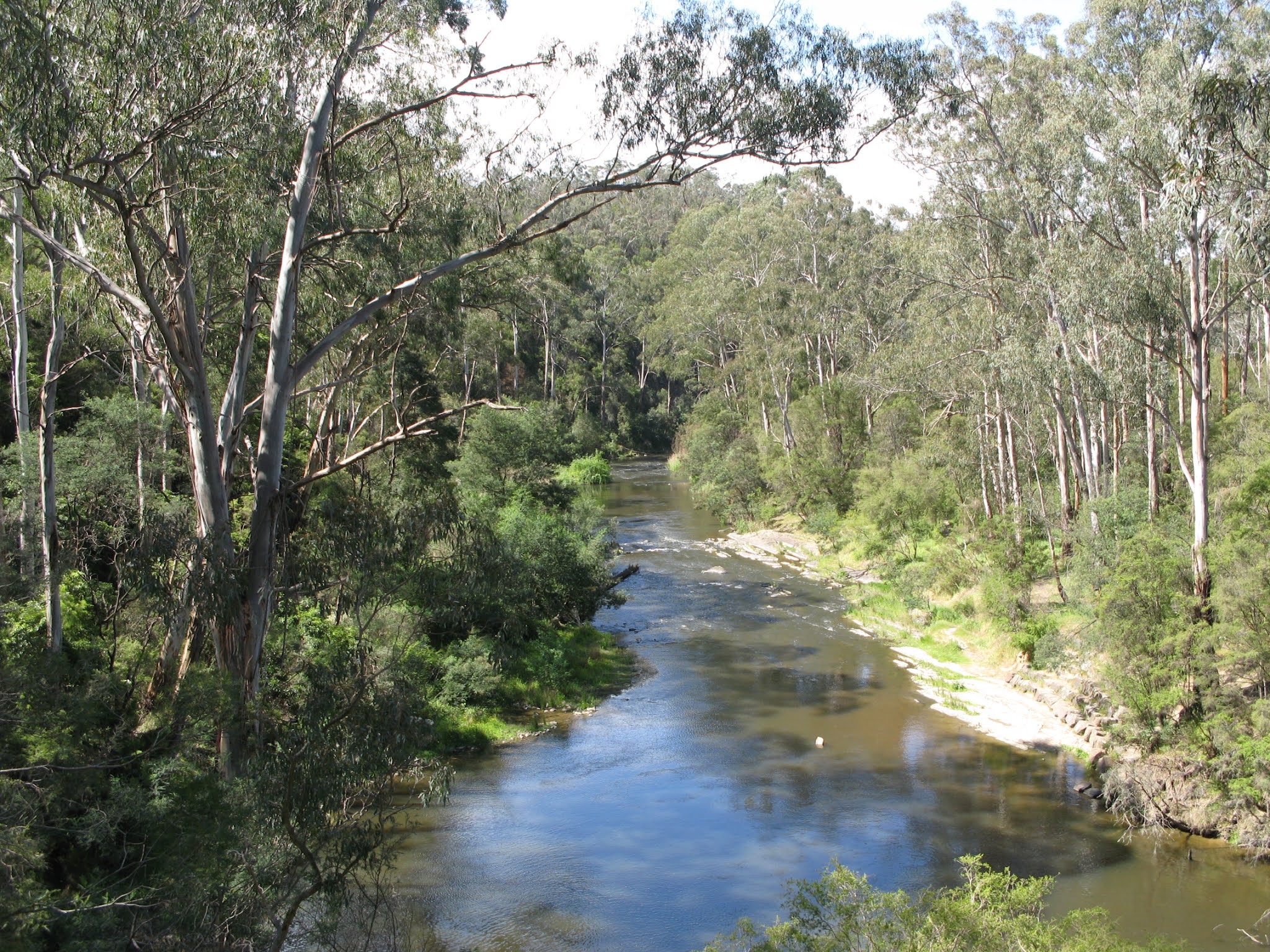
Upper Yarra River, Australia. Courtesy Wikimedia Commons.


      In the Yoder Lecture, which I delivered on October 15, 2017 to the American Folklore Society as "Ecojustice, Folklife and a Sound Ecology," I said that “In extending the idea of ecojustice to the Earth and all its beings, the ecojustice movement would in my view do well to consider these beings—including plants, nonhuman animals, landforms, and so forth—as persons, with the justice and rights that persons deserve. Needless to say, this is not how we in the modern, Euro-American world usually think of justice. We extend only limited rights to beings outside the human world, as for example in our laws against excessive cruelty to the higher animals.” After the lecture, one of the two discussants pointed out that there was, also, a downside in considering these beings persons; namely, that in bringing them into the legal system it would also risk subjecting them to adverse judgments, to obligations that accompany rights, and to other encumbrances of the law, which seemed unwise. I’d spoken about traditional and Indigenous ecological knowledges of nature in that lecture, but did not have the time to speak a rejoinder and say that for many Indigenous peoples, nonhuman beings are like persons, in some ways are kin, and do have standing. In the meantime, I’ve thought more about this issue, but only recently learned that it has been pursued in the courts and legislature in Australia, in response to Aboriginal peoples’ activism. Indeed, it was in 2017 that the Yarra River Protection Act was passed in Parliament, which recognizes the river as a living entity. The Yarra River runs some 150 miles through the Yarra Valley and into Melbourne before flowing into Hobson’s Bay. For the Australian settlers, this recognition fits within the scientific portrait of the river as an integrated ecosystem. But for the aboriginal Wurundjeri the river means something more than that, which also is carried in the concept of personhood: the river with its fish, and its birds, and its land corridor, is a relative, their kin, a sacred, life-giving ancestor. Personhood, in this sense, carries with it a good deal more than mere legal standing and the right to protection.  

Saturday, March 27, 2021

Salon April 9: Folk Knowledge, Environment and Sustainability

 On April 9 at 11 a.m. US eastern daylight time, Mary Hufford, Katey Borland and I will co-host an internet "salon" on folk knowledge, environment and sustainability. The salon, sponsored by the American Folklore Society Fellows, is open to those who attended the March 10 Webinar on Heritage, Folklore, and the Public Sphere:

To participate in the April 9 salon, one must pre-register here. Our  salon is a follow-up to my presentation on that topic for the AFS last March 10, which may be viewed here, beginning at 1 hour, six minutes, and thirty seconds in: Mary Hufford introduces me and I speak for ten minutes on this topic. If you prefer a transcript, in my previous blog entry I printed a draft which was identical to what I presented in the Webinar. I feel fortunate to have two outstanding salon co-hosts in Mary and Katey, each bringing their perspectives on the topic to the salon. Nonetheless, the idea for the salon is for us to host a discussion, not to present our ideas only. Several hundred people attended the Webinar; we look forward to hosting many of you on April 9 at 11 a.m. e.d.t. for a stimulating discussion. We want to hear what you think.

Environmental sustainability has been around in one form or another for more than a century but it has taken on a new urgency in our era of climate change. Cultural sustainability is a comparatively new topic. I began speaking about it to the American Folklore Society in 2006, drawing on sustainability discourses in ecology and also in economics (i.e., sustainable development). Modernization and development have taken a toll on the environment. Is sustainable development the answer? The United Nations thinks so. Or is sustainable development, like sustainable growth, an oxymoron? What is the place of culture, especially traditional expressive culture, such as folk and Indigenous knowledges, in public policy that emphasizes sustainable economic development?  Here is the description of the salon:

This salon will consider how public folklore and heritage programs can foster the sustainability of the natural environment and development of society as a whole.  How do cultural and environmental sustainability differ?  What difference does that make for folklore research and practice?  Querying assumptions bundled into sustainability frameworks, we will explore emerging models for culturally-driven sustainability. How do these models bear on the achievement of the UN’s Sustainable Development Goals? What opportunities does the U.N.’s IPBES program represent for public folklore?  What are the most productive questions that folklorists are exploring with communities to arrive at models for sustainable development?  


Monday, November 30, 2020

Music Ecology, Ecosophy and Ecosystem Services

Reviewing the controversy over the so-called music ecology trope, i.e., the idea that a music culture can be regarded as an ecological system, I think it may be helpful to re-orient the division I drew about fifteen years ago between ecological and economic discourses surrounding sustainability. At that time I thought that the ecological discourse was best represented by conservation biology and its approach to environmental sustainability, while the economic discourse was best represented by the Brundtland Report’s Our Common Future and its emphasis on sustainable development. But for the past eight years or so I’ve found it helpful to think of the ecological discourse surrounding sustainability as more diverse than what conservation biology represented. 

It may be useful to distinguish between two strands within the ecological discourse on sustainability. One is an ecosophical strand, represented to some extent by the deep ecologists, who retain the idea that there is an optimal state towards which nature, in the absence of human intervention, inexorably moves; and that therefore human beings ought to either get out of the way or if intervention for sustainability is necessary, one must “help nature along” or “do as nature does” and “follow nature.” Human beings are viewed as part and parcel of nature, as inhabitants or citizens of nature, not as superior to it or dominant over it. This strand of thought is also found among many environmentalists who do not think of themselves as ecologists, or who often conflate ecology with environment, as in usages like “ecological collapse” instead of “ecosystem collapse.”

The other strand is pragmatic, and it is represented by contemporary ecosystem ecologists who think of nature as a complex system that  moves through one environmental disturbance to the next, each one followed by a regime change, and a temporary equilibrium which may be more or less desirable than the one prior. There is no such thing as a “natural” tendency to move toward an optimal, climax state of dynamic equilibrium. Human beings are still part and parcel of nature, but nature can also be evaluated in terms of the “services” or benefits that ecosystems offer to humankind. To that end, ecosystems are managed for movement in more desirable directions, and when those are reached they are sustained insofar as possible by means of resilience strategies.

Saturday, October 31, 2020

Keeping Track of Writing Projects

Scholar sharpening his quill, by Gerrit Dou (Dutch, 17th c.)


    Although I don't have a quill pen, as does the scholar in this painting courtesy of the Wikimedia Commons, I thought I’d offer readers glimpse into some of my scholarly writing projects going along during the second half of this calendar year, and where they stand. Compared to this blog which is aimed at the public, these projects may appear esoteric and begging for translation. That would be a useful future task for this blog. Yet this blog originally was intended as a research blog, a basket of ideas mainly for my own use. But the writerly voice that emerged wanted to write for the public, not mainly for myself. This entry will be a change of pace, then, because it's going to be much more like that basket.

    I want to say also that besides writing projects, like most people in the United States today I’ve been much absorbed this year with activities surrounding the upcoming elections, local, state, and national, to take place in only a few days, although the results may not be known as quickly this year as usual. But this isn’t a blog about elections and politics.

    It seems no week goes by without something needing to be done on an article, a chapter, or a review in progress. I couldn’t possibly have involved myself in these writing projects while I was a professor, because during the academic year I spent almost all my work time in teaching, advising, and administrative work. Now in retirement I have no teaching or advising obligations—at least, no formal ones—and the only administrative work I’ve been doing has been for the academic societies to which I belong. Before I retired, I was able to work on writing projects only during summers (when I had no teaching obligations) and semesters or years on leave with fellowships or grants, often combining those with sabbaticals. Now in retirement I have much more time to read freely, and to write when I wish to. Here, then, is a brief description of some in-progress writing projects.

    1. “Ethical Considerations for Ethnomusicologists in the Midst of Environmental Crisis.” This is my chapter in a book in progress edited by Jonathan Stock and Beverley Diamond called the Routledge Companion to Ethics in Ethnomusicology.  The initial draft of my chapter was due on August 31. I just barely sent it in by the deadline. The abstract: "Ethnomusicologists’ “primary ethical responsibility is to their research participants,” according to the 2018 SEM Statement on Ethical Considerations. The Statement asserts further that in some cases this responsibility must be extended to “natural flora, and fauna, and human relationships to these.” What happens when these two principles are in conflict? I re-examine, from an ethical standpoint, a longitudinal research study among a musical community of coal miners whose industry harms the environment and themselves, rendering them vulnerable to both economic and environmental injustice. Resolution of this ethical conflict is rendered especially difficult because this community has a justifiable and longstanding distrust of outside do-gooders such as union organizers, social workers and environmentalists."

    1a. On October 23 I gave a brief and partial version of this chapter at a roundtable on “complicating the conversation about ethics in ethnomusicology” at the recent Society for Ethnomusicology conference.

    2. “Ethnography in the Study of Congregational Music.” This is a chapter on doing ethnographic fieldwork, with special attention to prospects and problems with ethnography in religious music-cultures. In this chapter I attempt to answer three questions: (1) What is ethnography? (2) What theories and methods offer a foundation for ethnographic research, and does religion present special difficulties? and (3) Why incorporate ethnography into studies of congregational music? The chapter is for a book long in progress that’s edited by Jeffers Engelhardt, Monique Ingalls, and Andrew Mall. It’s entitled Studying Congregational Music, also under contract with Routledge. This book has been in progress since 2015. Jeffers Engelhardt asked me if I’d write a chapter on ethnography for this volume in 2015; I accepted the invitation and submitted the chapter in May, 2016. More than four years went by as the rest of the authors wrote their chapters and the editors wrote their introductory material. Last month the manuscript underwent Routledge’s copyediting. My copyedited chapter was sent to me about two weeks ago, and I was given 7 days to go over the copyedits, answer questions, and make corrections. I managed to squeeze it in while also attending and presenting at the SEM conference, again just returning it before the deadline. Possibly I will see page proofs and have a chance to correct these as well, but it’s just as likely that the editors will take care of that. Most likely the book will be published in 2021, five years after I completed my chapter for it. That is a long time, but it’s not uncommon in an edited volume with a dozen or more contributing authors.

    3. “A Sound Economy.” This article is an expansion of one of the four topics of my “sound ecology” project. It is a chapter in a book in progress entitled Transforming Ethnomusicology, edited by Beverley Diamond and Salwa El-Shawan Castelo-Branco, under contract with Oxford University Press. I wrote my chapter in 2017, basing it partly on my plenary address for the 2015 “Transforming Ethnomusicology” forum in Limerick, Ireland; and on one of my four public Basler Lectures at East Tennessee State University in March and April, 2016. A sound economy is characteristic of a sound community and arises from the recognition of co-presence and a universal kinship by means of sound experience. These ideas are much elaborated in my sound ecology project, the latest summary of it having appeared in the last chapter of my book Toward a Sound Ecology, published last August by Indiana University Press. Last month the manuscript for Transforming Ethnomusicology underwent Oxford’s copyediting. My copyedited chapter was sent to me about two weeks ago, and I was given three weeks to go over the copyedits, answer questions, and update the citations and references, and make other corrections. I spent a couple of days last week doing this in down time from the SEM conference, and have been working steadily on it this weekend as well. I hope to complete it and send it back to the editors in a few more days. Possibly I will see page proofs and have a chance to correct these as well, but it’s just as likely that the editors will take care of that. Most likely the book will be published in 2021, four years after I completed my chapter for it.

    4. “An Ecological Approach to Folklife Studies, Expressive Culture, and Environment.” This article, like the first three, came as the result of an invitation—in this case from a group based at Indiana University that go by the acronymn DERT, which stands for Diverse Environmental Research Team. DERT consists of folklorists, ethnomusicologists, and ecomusicologists. The article will be published in a book under contract to the University of Illinois Press, entitled Diverse Environmentalisms: Expressive Culture and Environmental Change, edited by John McDowell, Katherine Borland, Rebecca Dirksen, and Sue Touhy. In this article I attempted once more to advance an ecological approach to folklife and the performance of expressive culture, returning to a topic that I first broached in my 1988 book, Powerhouse for God: Speech, Chant, and Song in an Appalachian Baptist Church. The abstract: "The performed word, whether spoken, chanted, or sung, offers more than an expression of culture in aesthetic form. From an ecological point of view, it articulates changing historical and contemporary relations among living beings and their environments. Theories from ecosystems ecology, when applied to sociocultural systems as well as biological ones, reveal that the performed word adjusts connections among people, material culture, animals, plants, landforms, and other aspects of the physical environment. Sacred language in particular is imbued with the power to alter relations and, therefore, to change beings, the environment, and the course of future events." The article goes on to illustrate these claims through a case study of environmental affordances, catastrophes, and life story narratives in a community in Virginia’s northern Blue Ridge Mountains, over a time depth of approximately 150 years. The DERT team editor that I worked with was more interested in the performed word than in ecology. In 2018 expanded the my 2017 draft of this chapter by adding a few pages about expressive culture, while I insisted on maintaining what I had written about farming, family, husbandry, and the effects of a changing physical environment, encouraging various adaptations and requiring others. I reviewed the copyedited manuscript two years later (i.e., in late July and early August), sending it back to the editors then. I hope to see page proofs either later this year or early next. We expect that the book will be published in 2021.

    5. “Earth Song: Music and the Environment.” Like the first four, this essay was written on invitation. In 2019 I was approached by Huib Schippers, then director of Folkways Records, about writing a short article for Alexander Street Press for a curriculum accompanying various albums featuring music and environment, in the Folkways Records catalog. It was to be a brief essay, no more than 3000 words (the first four averaged 8,000 words). I said I would do so, as long as I could write about the deep connections between music, sound, and nature. After they agreed, I wrote the essay and completed it shortly after Thanksgiving, 2019, and returned it then. In 2020 I’ve been corresponding all the while with Huib and some others who were hired for the project, advising them as they prepare a list of further readings to go with this essay and the curricular unit that it’s a part of. I’m not sure when it will be published; perhaps next year, perhaps later.

    6. A “response” chapter based on my presentation for an online conference at Dartmouth College, entitled “The Power of Song: The Cultural Politics of Singers Around the Globe,” to take place in early December. This, also, came about as a result of an invitation. I’m to respond to three presentations on “musical icons,” that is, people who make music and who have become performers who are more than just famous; they have become cultural symbols, they and their careers embodying beliefs deeply embedded in their societies. So far two of the three papers have arrived, but only one arrived by the deadline. As a result I’ve blocked out my response to that paper and will need to incorporate my response to the second paper shortly while I await the third. After the conference they will revise their conference papers and turn them into articles, and I will revise my conference response for publication in the book.

    7. “Eco-trope or Eco-tripe? Music Ecology as a Complex System.” This is an article in progress for a book edited by Aaron Allen and myself, called Sounds, Ecologies, Musics, under contract with Oxford University Press. The article is an expansion of part of my invited keynote address to the Irish ICTM conference in 2017, and part of the abstract goes like this: “Complex ecosystems analyses, environmental philosophy and ecological knowledges (from both Western science and indigenous populations) of sonic behavior, in both human animals and other-than-human animals, are complementary in ways that hold out the promise of re-centering sound connections and kinships. In this way, music/ecology becomes more than merely a metaphor. Employing ecological principles to understand sonic behavior among organisms and their environment, the music/ecology metaphor offers a path toward sound communities, sound economies, and a sound ecology.” My progress on this article has been gradual as I’ve been attending to the five that I listed above. I’m going to try hard to keep my desk mostly clear for the next couple of months so that I can finish up a draft.


Tuesday, April 7, 2020

Coronavirus soundscape - an ecocentric perspective

Hairy woodpecker. Photo by J. Titon
 What is the new soundscape of the novel coronavirus? In the built environment I hear less noise. Less noise from traffic, from shops, restaurants, factories. In the mix of traffic noise, more from work trucks and emergency vehicles with sirens; less from cars. More prominent in the spring soundscape now are the songbirds, singing away at dawn and through the day, staking out territories, looking for mates to build nests, and raise new broods. The human sounds, called anthrophony by soundscape ecologists, have diminished. More prominent now is biophony, the sounds of animals, and geophony, the sounds of wind, rain, thunder, and the like. Scientists tell us that songbirds find their acoustic niche in the soundscape so they can communicate with the least amount of interference from other sounds. Those who dwell near highways have evolved to sing in a higher-pitched range than others of their species who dwell far from highways. With less highway noise for a while, those birds will find less interference and be able to communicate better. Every morning at dawn I hear a pair of woodpeckers drumming their song, one closer and louder, the other farther away and softer. While human life seems to be in a mostly suspended state, it is comforting to hear the songbirds.

Monday, February 24, 2020

Toward a Sound Ecology: New and Selected Essays


Indiana University Press has announced my new book, Toward a Sound Ecology: New and Selected Essays, to be published in August, 2020. The book gathers together a dozen of my published articles from 1980-2015, along with a new essay that's a summary of my ongoing sound ecology project. The table of contents:

I. Field Work
     1. The Life Story (1980)
     2.  Ethnomusicology as the Study of People Making Music (1989)
     3.  Text (1995)
     4.  Knowing Fieldwork (1994)
     5.  Applied Ethnomusicology: A Descriptive and Historical Account (1995)

II. Cultural and Musical Sustainability
     6. "The Real Thing": Tourism, Authenticity and Pilgrimage among the Old Regular Baptists at the 1997 Smithsonian Folklife Festival (1999)
     7. Music and Sustainability: An Ecological Viewpoint (2009)
     8. Sustainability, Resileience and Adaptive Management for Applied Ethnomusicology (2015)

III. Toward a Sound Ecology
     9. A Sound Commons for All Living Creatures (2012)
    10. The Nature of Ecomusicology (2013)
    11. Thoreau's Ear (2015)
    12. The Sound of Climate Change (2016)
    13. Toward a Sound Ecology (new)

I've discussed aspects of much of this writing in previous blog entries. Here instead it might be of some interest to recap a few of the steps that led to this book. This could be helpful to other scholars thinking of publishing with a university press.

Book publishers are always looking to find good manuscripts to publish, and university presses, which publish scholarly and scientific work, are no exception. But whereas the commercial (trade) presses usually deal with agents that try to sell their authors' books to the highest bidder, academics who publish with university presses very seldom have agents while the presses usually don't give advances on royalties. Younger scholars--that is, those who have not yet published a book or very many essays in scholarly journals--are best advised, when they have book manuscripts in mind, to seek out university presses known to publish heavily in the area of their specialty. For example, in American folk and popular music, these are the presses associated with the universities of Illinois, Mississippi, Tennessee, Indiana, Wesleyan, Oxford, and California. 

Editors from these and other presses regularly attend the annual conferences of scholarly societies such as the Society for Ethnomusicology, the Society for American Music, the American Folklore Society, the American Musicological Society, and so on. Of course, other academic disciplines have their own societies and conferences: for instance, the American Anthropological Association, the American Psychological Association, the Modern Language Association, and many others. Younger scholars are well advised to travel to these conferences and seek these editors out at the book exhibits and make appointments with them to meet in person at the conference and discuss the book they have in mind. Most often, it's a book that's based on their PhD dissertation. The editors will show varying degrees of interest, usually writing down the details and, if they think the topic fits within the scope of the books they're currently bringing out, asking the scholar to contact them when ready with a book proposal detailing the book's projected contents, and saying something about the market that the author envisions--chiefly for libraries and for students taking courses, or with some appeal to a general audience as well. 

The young scholar then submits the proposal to the press that seems to have the best "fit," the one that is most desirable, and/or with the editor who's shown the most enthusiasm for the book project. The press conducts an in-house review of the proposal, and they may also send it to an external reader. If the proposal generates enthusiasm, the press will offer the scholar an advance contract (though usually without a monetary advance). The contract usually states that the author will submit the manuscript to this press (and no other) when it's ready, and that the press will then give a formal review to the mansucript and let the author know their decision. Such a contract doesn't guarantee the author very much except for a review, but it does provide psychological help to know that a press is interested. 

After the young scholar submits the manuscript, it gets an in-house review and, assuming it's positive, the press then sends it to external readers, usually two of them, for their assessment. This external review is often conducted "blind" -- that is, the reviewer isn't told who is the author, although often it's easy to figure it out if the reviewer so chooses. If the external reviews are negative, the press tells the author that they won't go ahead with publication. If they're positive, they usually come with some suggestions for revision, in which case the press asks the author to respond to the reviews--that is, to write a response--and then to make the revisions that they think will be helpful. Often there's some negotiation here between the author and the press over how much revision is needed or wanted. Regardless whether the reviews are negative or positive, the names of the reviewers are withheld from the authors. With positive reviews, suggestions, and negotiations, the author revises the manuscript and re-submits. Often the revised manuscript is returned to the external reviewers for their approval, but not always. The press then usually decides to go ahead with publication, and the author prepares the manuscript, obtaining necessary permissions, making certain that it conforms to the "style" that the press follows (footnote form, bibliography, citations, references, etc.), and then returns it to the press. Some time later, the press puts it into production and gives it to a copyeditor who may make suggestions for improving the writing (usually for clarity) and will make sure it conforms to the press "style." It's then returned to the author who reviews the copyedits and makes further revisions before sending it back to the press. The press then gives it over to a printer who makes page proofs. These are then sent back to the author who checks the whole manuscript for accuracy. At this stage only very small changes in the form of correction are permitted. Returned once more to the press after the proofs are checked, the printer is given the go-ahead and the book takes its place in line at the printer's, to be published some months later. 

In its entirety this is a time-consuming process. My first book, for example, Early Downhome Blues: A Musical and Cultural Analysis, grew out of my dissertation. I completed the dissertation in 1971 and sent it to the University of Illinois Press. They returned it with an advance contract and some suggestions for revision made by an in-house editor. Because I was also teaching full-time, it took me quite a while to turn it into the book I wanted. In January of 1974 I sent the press my revised manuscript, and they sent it to two external readers. After six months passed, the press sent me back the reports, which were positive. I made some revisions and returned the manuscript at the end of 1974, and they issued me a formal contract. I had no more to do but review the copyedits and page proofs. For reasons having to do with the press' production schedule, and the fact that they wanted to put the book into a new series they were launching (Music in American Life) but not as the first book in the series, publication was delayed until 1977. When it fell out of print about fifteen years later, the University of North Carolina Press asked me if I'd write a new Afterword for a second edition. I agreed, and they published the second edition in 1995.

After an author has published a book or several articles and begins to get a reputation as someone who's knowledgeable in an academic field, it is easier to find a university press. After an author has become an acknowledged expert, press editors may be the ones to initiate contact with authors, asking them if they are working on a book manuscript that would be suitable for them. For example, in 1977 I'd won a fellowship from the National Endowment for the Humanities, and a list of fellowship recipients was made public along with the research subjects the scholars proposed to work on. A month later I received letters from editors at the University of Texas Press and the University of North Carolina Press asking me what I was working on and to keep them in mind when it came time to publish. Nevertheless, even with established scholars the same review process takes place, involving a proposal, review, manuscript submission, further review, etc. It took me another ten years to complete the book for which I'd held that fellowship. Powerhouse for God: Speech, Chant, and Song in an Appalachian Baptist Church was published by the University of Texas Press in 1988. It fell out of print about ten years later, but it was published in a second edition, with a new Afterword, in 2018, by the University of Tennessee Press.

In 2013 an acquisitions editor at Indiana University Press inquired about my work in ecomusicology. Possibly my name had been recommended to her by one of the editors of a new series they were starting, called Music, Nature, Place. It happened in 2012 I'd given a paper at an ecomusicology conference, and in 2013 just before she contacted me I'd  given a keynote address on ecomusicology to the Brazilian Society for Ethnomusicology. A year earlier I'd also published my appeal for a sound commons for all living creatures. I forwarded them to this editor who read them and said that if I were working on a book in this area, she'd like to be able to consider the manuscript for IU Press.

Toward a Sound Ecology was solicited in this way: in 2015 the same IU Press acquisitions editor asked me if I'd have lunch with her and the director of the press, at a folklore conference. At the lunch they asked me whether I'd made any progress on my sound ecology project and I replied yes, but that completion was likely still many years away. I told them I'd been asked to step out of retirement to occupy an endowed chair as a visiting professor, and that one of my duties was to give a series of four public lectures. I intended to explore four aspects of that project, one in each lecture: sound presence, sound community, sound economy, and sound ecology. The project, I said, was still expanding and I kept getting new ideas. They then asked me then whether I'd be willing to propose a different book to them for now, one consisting mainly of my already-published essays on topics that were still current, including a few of my most recent ones on aspects of the sound ecology synthesis that I was seeking, adding one or two new essays to the group. I said that I'd be happy to do so, and that is how this forthcoming book was born. Its third section, "Toward a Sound Ecology," gathers some of my essays related to that topic, and ends with a new one that summarizes my thinking at the time of its completion last summer.